An EPE liner only seals reliably when its geometry, compression, bottle finish, cap application force and product chemistry work together. By the end, you will know how to choose the liner structure, test the cap-and-bottle combination, identify failure causes and decide when another closure system is more suitable.
Key takeaways
- Keep the EPE liner flat, centred, and fully supported inside the cap.
- Match liner diameter and thickness to the bottle finish and closure design.
- Test chemical compatibility, compression, torque, and sealing temperature together.
- Approve samples with leak, seal, and line-performance checks before production.
How an EPE liner sits inside the cap
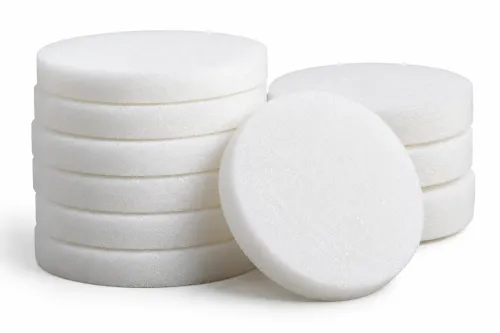
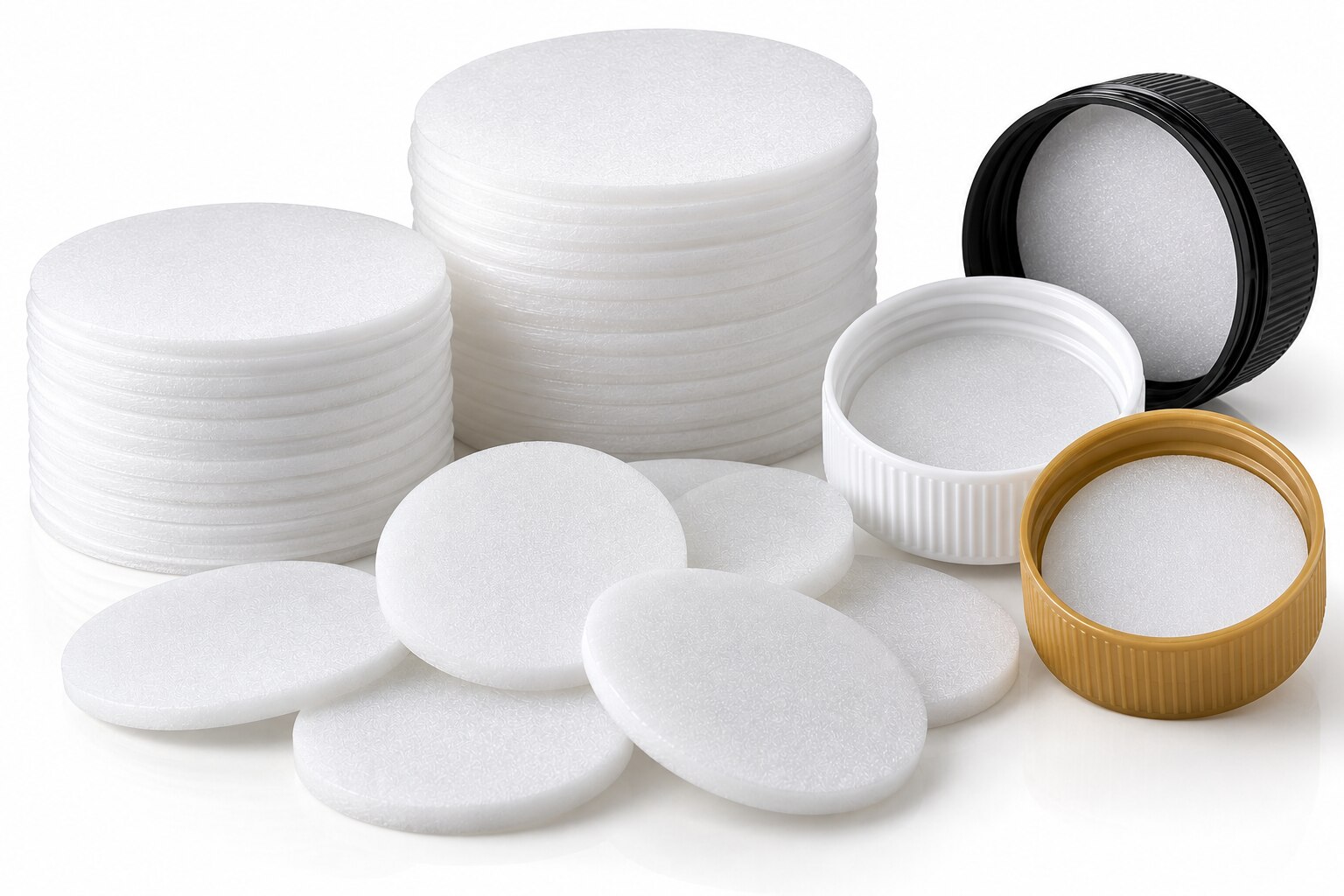
An EPE liner is fitted into the cap as a loose insert, a retained insert held by a cap shoulder or plug, or a component placed during cap assembly. The liner must lie flat and concentric; a tilted liner creates an uneven compression path and can leak even when its diameter looks correct.
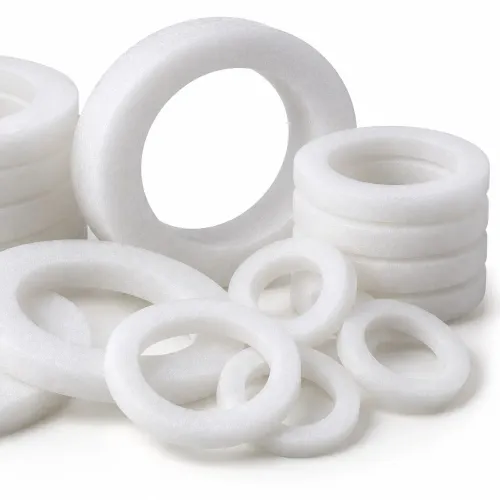
An EPE ring liner contacts the bottle’s sealing land in an annular band while leaving the central opening uncovered. Use it when the bottle finish provides a continuous outer sealing land and the product does not require the liner to cover the entire mouth.
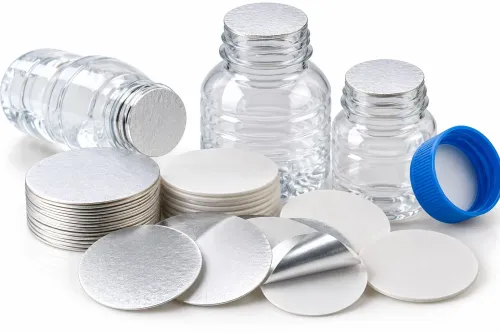
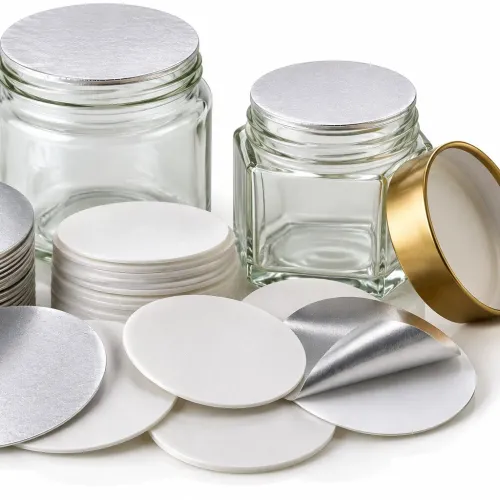
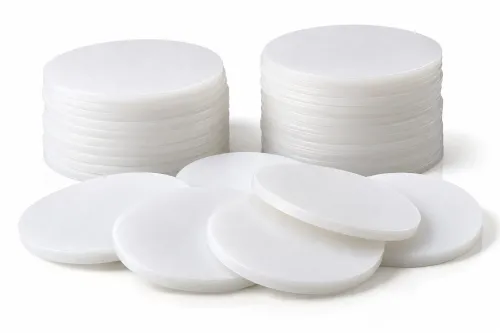
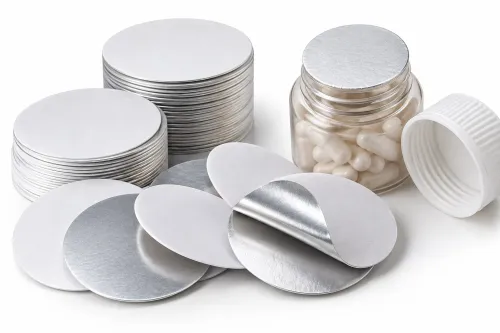
A full-disc EPE wad covers the complete bottle opening. Choose it when the closure needs full-face cushioning, protection from dust or moisture, or support for an induction structure containing foil and a heat-seal coating. EPE alone is not a hermetic induction seal: the foil susceptor and bottle-compatible sealant create that permanent seal.
A bottle cap gasket is a compressible sealing element fitted into the closure; it may be a ring or full disc and may use EPE or another elastomer. It is the right description when the closure relies on repeated compression rather than a bonded membrane.
Check the fit before running production:
- Confirm the liner is retained without buckling or falling out during cap handling.
- Match polyethylene sealant to HDPE or LDPE, and polypropylene sealant to PP.
- Verify cap torque supplies compression without squeezing material into the threads.
- Reject closures with damaged threads, tilted caps or an uneven bottle finish; EPE compliance cannot correct them.
How to match liner dimensions to the bottle finish
Measure the sealing land, not just the bottle’s outside neck diameter. Record the land’s outside diameter, inside diameter, width, flatness and continuity, plus the finish height, bore diameter, thread profile and thread start.
A liner diameter that is too small leaves the land partly uncovered; one that is too large can buckle against the cap wall.
| Measurement | Record | What it controls |
|---|---|---|
| Bottle finish | Land diameters, width, bore, height and ovality | Liner diameter and contact area |
| Cap cavity | Internal diameter, depth, shoulder shape and retention feature | Disc clearance, seating and liner diameter |
| Closure system | Cap thread, application torque and axial travel | Available compression and liner thickness |
| Liner material | Thickness, density, cell structure and recovery | Resilience, cushioning and sealing consistency |
Select liner thickness from the axial gap between the cap’s seating surface and the bottle land after the cap reaches its specified position. The liner must compress enough to maintain contact, but not so far that it crushes, spreads into the thread or makes opening difficult.
Document liner compression ratio concerns alongside torque, peel force and leak limits; do not use torque alone to prove sealing.
Specify liner density with the grade and thickness. Low density improves compliance, while higher density can resist collapse under load, but neither corrects a tilted cap, damaged thread, flash, ovality, contamination or a broken sealing land. Check trial closures at dimensional extremes before approving the size.
How product chemistry and closure conditions change the choice
An EPE liner will withstand the product and closure conditions only when its grade, density, thickness and cell structure match the application. EPE chemical compatibility is usually good with water and many chemicals, but oils, solvents, surfactants and concentrated formulations require testing against the actual product, not a generic compatibility chart.
Check these conditions before selecting it:
- Temperature limits: obtain the supplier’s continuous and short-term temperature ranges, then test the filled pack through hot filling, cooling, transport and storage. Excess heat can distort the liner; cold can reduce resilience and opening performance.
- Compression set: hold the closed pack for the planned storage period, then measure sealing contact and opening force. Permanent compression loss can create leaks even when the liner looked sound on the filling line.
- Pressure: treat EPE as a compliant backing, not a hermetic pressure seal. Gas-generating products, carbonation and altitude changes require a properly designed heat-seal layer and adequate closure compression.
- Opening: decide whether the foil should remain attached to the bottle or the complete liner should remove with the cap. One-piece and two-piece induction liners have different peel forces and consumer-opening behaviour.
Induction sealing versus EPE is not an either-or choice: EPE supplies cushioning, while an induction wad normally uses foil and a container-compatible sealant to create the permanent barrier. Validate the finished pack after product exposure, temperature cycling, vibration and storage time.
A passing immediate leak test does not prove polymer relaxation has not changed leakage or opening force.
How to verify a seal and diagnose leaks on the line
A leak that appears only after induction sealing points to the application window, not automatically to the EPE liner. Start with an unsealed, correctly capped bottle: if it leaks before induction, investigate the bottle finish, cap, thread engagement or closure force.
1. Run leak testing on samples before and after induction. A pre-sealing failure identifies a bottle, cap or torque problem; a post-sealing failure directs attention to liner placement, heat transfer or seal formation.
2. Perform seal inspection after removing the cap. Look for a continuous bonded or wetted ring around the sealing land. Gaps, narrow bonding, scorched areas, wrinkling, foil damage or product trapped under the seal indicate poor contact or excessive heat.
3. Check liner displacement in the cap and on the bottle finish. An off-centre, tilted, folded or stuck liner points to cap retention, insertion or handling damage rather than generator power.
4. Use cap torque testing to compare application torque and removal torque with your approved limits. Low torque permits leakage through incomplete compression; excessive torque can distort the cap, squeeze product into the seal area or create misleadingly high opening force.
5. Change one process variable at a time: line speed, coil-to-cap distance, power, cap geometry or container material. Underheating leaves channels; overheating can shrink the liner, deform the sealant or damage the foil.
Separate leak performance from opening performance. Record liner peel force, residue and fragments after opening, then repeat leak testing after cooling, temperature cycling, product exposure and vibration; an immediate pass does not prove a durable seal.
How to approve the liner before full-scale production
A sound liner approval process moves from documents to samples, then to a controlled line trial and defined release criteria. Do not approve an EPE-lined closure from a supplier sample alone.
1. Require a controlled drawing stating liner diameter, thickness, density, construction, tolerances, cap fit and intended sealing method. Request the resin grade, foil or polymer seal layer, adhesive, coating, ink and processing-aid details; “EPE liner” alone does not control performance.
2. Review migration documentation for every layer that can contact the product or migrate into it. For U.S. food-contact use, check each material’s authorization or compliance basis, including whether 21 CFR 177.1520 applies to the specified olefin polymer; it does not approve the assembled liner automatically.
3. Fit samples to production bottles and caps. Check seating, centring, compression, cap application and removal. Record leakage, peel force, opening torque, residue, tearing and delamination as separate results.
4. Run a line trial at minimum, nominal and maximum speed. For induction sealing, record generator settings, coil-to-cap distance, cap torque, container material, product temperature and seal temperature. Confirm the process window rather than approving nominal power.
5. Conduct filled-pack storage and handling trials at the intended temperature range, then inspect leaks, seal integrity and opening performance. Define acceptance limits before testing.
Require a certificate of analysis, test methods, batch or lot number, certificate of conformity, shelf-life statement and written change-notification commitment. Lot traceability must connect finished closures to liner material and production records. Surya Products Limited can support this review when its liner specification is tied to your cap, bottle and process data.
Related products
 | EPE Ring Liners EPE Ring Wad For Fridge Bottle Cap An EPE ring liner is a type of liner made from expanded polyethylene foam that is commonly used in fridge bottle caps to provide a seal between the... View product → |
 | Epe Gaskets & Ring Liners These are EPE RINGS , Epe Gaskets for Spray Pump Caps , Mist Pump Caps , Sanitizer bottle Caps , Liquid detergent Caps , Lotion Pump Caps , Water... View product → |
Frequently asked questions
How should an EPE liner sit inside a bottle cap?
It must lie flat and concentric. A loose insert, retained insert, or assembly-placed liner must avoid tilting because uneven compression can cause leaks.
How do you match an EPE liner to the bottle finish?
Compare the liner’s diameter, thickness, sealing area, and fit with the bottle finish, cap dimensions, thread design, and closure support features.
Which conditions affect EPE liner selection?
Review the product’s chemistry, filling temperature, storage conditions, closure torque, compression, and sealing process before selecting the liner.
How do you verify and approve an EPE liner before production?
Run line trials, inspect liner placement, check seal integrity and leaks, record closure conditions, and approve samples before full-scale production.
Related products
 | EPE LINERS WADS These are EPE LINERS & WADS used in Metal & Plastic Caps for Air tight , Leakage control And Moisture control from Bottles. View product → |
 | EPE LINERS / WAD Co-extruded 3 Layer EPE LIENRS Represents a single piece Expanded Polyethylene foam liner Material in punched Discs to specific dimensions or in Roll... View product → |
 | EPE Ring Liners EPE gaskets are commonly used in dispensers to prevent leaks and maintain hygiene. View product → |
 | EPE LINERS WADS Used in Metal caps , available in all sizes and density View product → |