The right bottle sealing wad depends on the product’s physical state, chemistry, container material, closure geometry and required shelf life—not simply on whether the bottle is plastic or glass. By the end, you will be able to compare liner constructions, match one to your package, set up the sealing process and define tests that distinguish a secure seal from a merely attractive one.
Key takeaways
- Match the sealant layer to the bottle material and closure finish.
- Remove product residue from the rim before induction sealing.
- Choose barrier layers according to moisture, oxygen and shelf-life risks.
- Test seal strength, leaks and ageing before approving a wad.
Choose the Wad by Product State and Shelf-Life Risk
Water-like liquids need a foil-laminate induction wad with a sealant matched to PET, HDPE, glass or the actual container finish. Viscous liquids need the same construction, plus strict control of filling residue: a sauce film across the rim creates channels and leaks.
| Product state | Suitable wad construction | Main selection risk |
|---|---|---|
| Water-like liquids | Hermetic foil induction liner | Match sealant to container resin |
| Viscous liquids | Foil induction liner with strong wetting sealant | Clean the sealing land after filling |
| Oils | Oil-resistant foil laminate | Test sealant swelling and bond loss |
| Solvents | Chemically compatible foil laminate | Run storage tests with the actual solvent |
| Powders | Powder sealing liner with containment-focused seal | Dust can block heat-seal contact |
| Granules | Robust induction membrane or reinforced liner | Particles can hold the liner off the rim |
| Hygroscopic powders | High-barrier foil laminate | Specify a hygroscopic powder moisture barrier and measure moisture ingress |
| Dry foods | Foil or metallised barrier laminate | Protect moisture, oxygen and aroma shelf life |
Pulpboard and foam liquid bottle sealing wads cushion uneven finishes but are not automatically moisture- or oxygen-tight. For dry food packaging, choose a tested barrier membrane when texture, crispness, aroma or contamination limits shelf life; a water-leak pass alone proves too little.
Use a vented membrane only when trapped air or gas generation requires it. Validate the vent filter against particles, moisture and the required shelf life, because venting reduces containment and barrier performance.
Understand Which Layer Seals and Which Layer Stays in the Cap
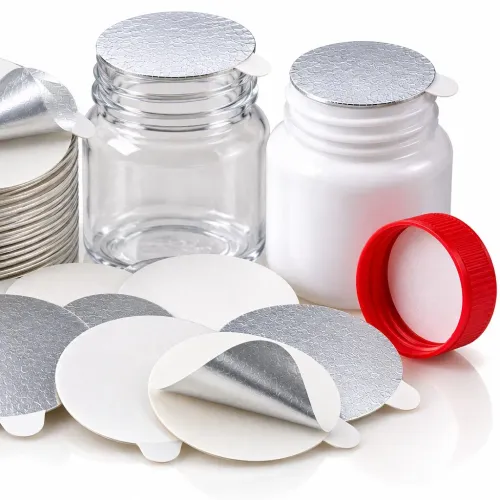
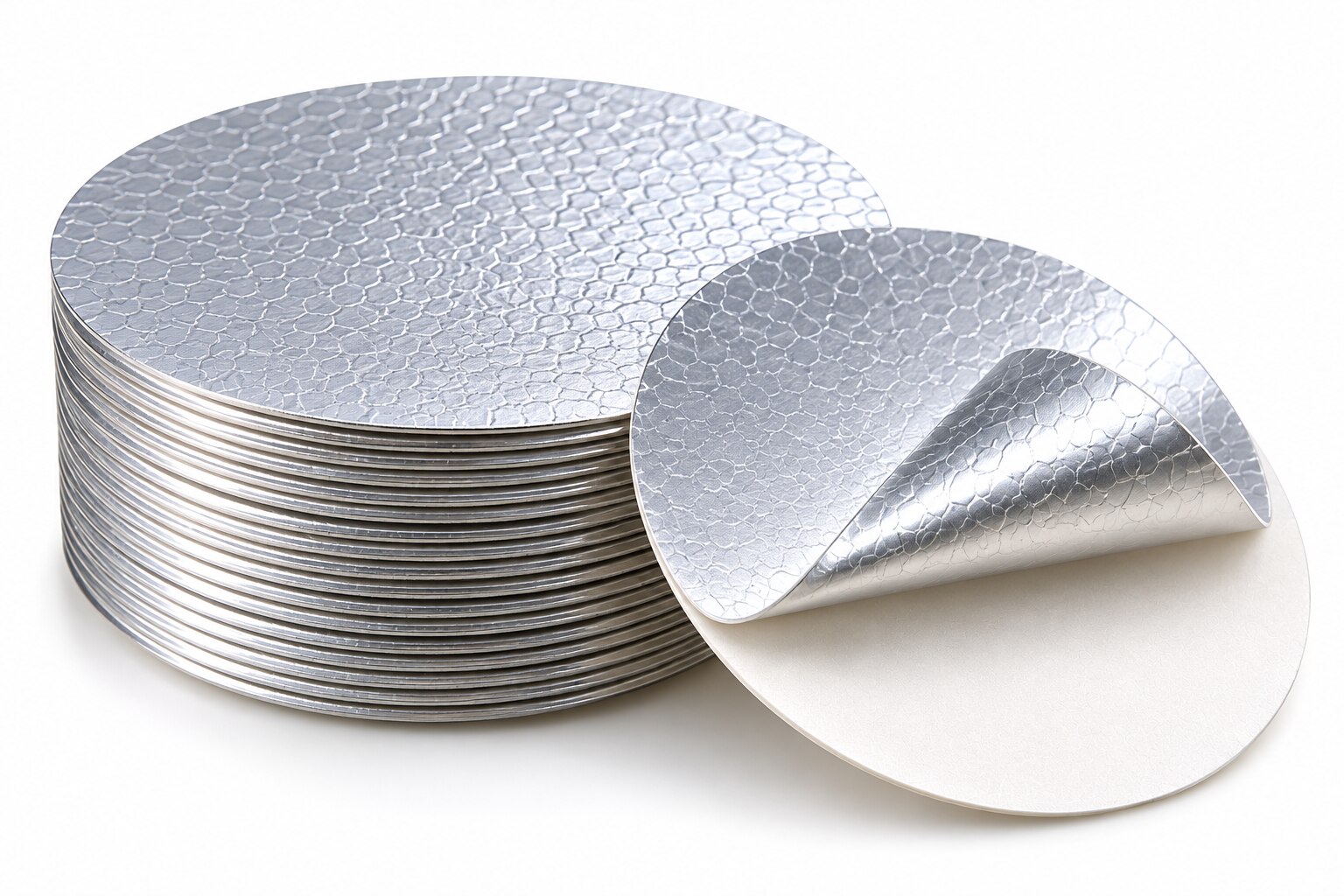
The heat-seal coating—not the aluminium foil—bonds to the container finish. A typical induction stack runs from cap to bottle as backing, aluminium foil seal, heat-seal coating, and container rim; the backing determines what stays in the cap after opening.
| Option | Layer construction | Opening and resealing behaviour | Pull-tab use |
|---|---|---|---|
| Pulpboard or paperboard | Compressed fibre, sometimes wax-coated | Usually remains in the cap; compression can provide basic resealing, not a hermetic barrier | Rare; usually removed by lifting the cap |
| Foam, such as EPE | Compressible foam, with or without a facing film | Stays in the cap and cushions the rim; reseals by compression but can lose recovery after repeated opening | Uncommon |
| Pressure-sensitive | Paper, foam or film carrying pressure-sensitive adhesive | Adhesive bonds under cap pressure and can transfer to the rim; the cap provides reclosure, but adhesion and cleanliness control performance | Possible only with a projecting tab or slit |
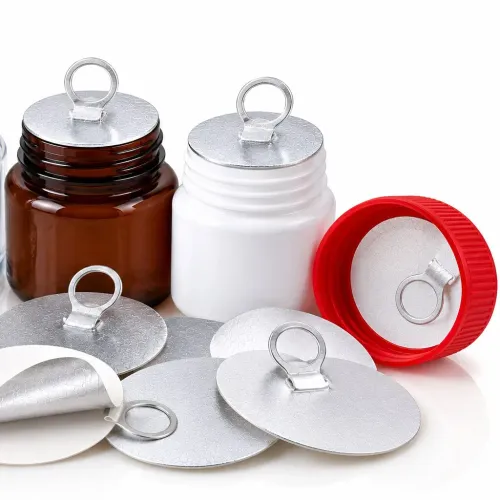
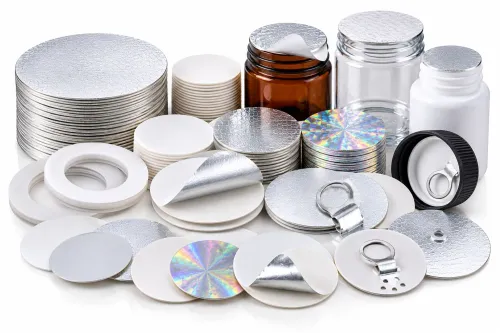
| One-piece induction liner | Backing permanently attached to foil and sealant | The complete liner remains on the container after the first opening; the cap closes over it for reclosure | Commonly designed with a pull-tab |
| Two-piece induction liner | Aluminium foil seal with sealant, plus a separate backing disc | The foil membrane seals to the container while the backing stays in the cap; the exposed membrane is removed, so reclosure relies on the cap | Foil pull-tabs are common |
Choose pulp or foam for cushioning and basic product separation, not as an automatic substitute for an aluminium foil seal. A one-piece induction liner leaves no loose backing in the cap; a two-piece induction liner makes membrane removal clear but leaves the container without a liner for resealing.
Match the Wad to the Container, Closure and Product Chemistry
A wad that seals HDPE can leak on PET or glass, so check the container resin, surface coating, neck finish and sealing land before choosing it. Measure the land’s diameter and width, inspect for ovality, flash, warping and damaged threads, and confirm that the liner covers the land without extending into unsupported areas.
An HDPE bottle liner needs a sealant matched to polyethylene; a PET bottle induction seal needs a coating proven for PET. Glass container sealing requires a glass-compatible sealant, or a suitable coated closure surface.
Check product chemistry as well. Oils, solvents, surfactants, powders and moisture can weaken bonds or contaminate the land. The sealant—not the aluminium foil—must resist the product.
| Option | Choose it when | Main limitation |
|---|---|---|
| Induction liner | You need a hermetic, tamper-evident seal or protection from leaks, oxygen and moisture | Requires matched sealant, clean lands, controlled torque and induction equipment |
| Pressure-sensitive liner | You need simple application and easy opening for dry, low-risk products | Adhesive seals are not equivalent to a tested hermetic seal |
| Foam or pulp liner | You need cushioning, closure fit or resealing | It does not provide reliable leak integrity by itself |
| Heat-seal liner | The container and liner tolerate direct heat with a compatible sealant | Contact heating can distort containers or slow the line |
| Shrink-band | You need visible evidence that the closure was opened | It is not a primary liquid or vapour seal |
| Foil-backed liner | You need barrier performance only when its construction includes a tested heat-seal layer | Foil alone will not bond to the container |
Choose induction when leakage, tampering or shelf-life risk justifies the added process control.
Run the Induction-Sealing Process Without Creating Hidden Defects
A clean, evenly supported sealing land is the foundation of the induction-sealing process. Control the filling operation as tightly as the sealer; a good membrane cannot bridge a powder particle, oil film or sauce residue.
1. Set the fill level below the neck so liquid does not wet the rim. For powders and granules, control dust at the filler and remove loose product before capping. Prevent powder contamination sealing failure by checking every sealing land.
2. Inspect the container finish before applying the closure. Reject warped or oval rims, flash, damaged threads and deep scratches; these defects create partial seals even when the machine runs normally.
3. Place the liner centrally, with full coverage of the sealing land but no unsupported overhang. Confirm that the liner remains flat inside the cap and that the closure seats squarely.
4. Establish cap torque for this exact bottle, closure and liner combination. Uniform compression matters more than copying a torque value from another package; loose caps create gaps, while excessive torque can distort the neck or liner.
5. Set induction power and dwell time through trials at the planned line speed. Increase energy only until the seal is continuous; excess heat can wrinkle or burn the membrane, squeeze out adhesive or delaminate layers.
6. Fix the induction-head gap and keep containers upright through the field. Recheck settings after changing neck material, wall thickness, cap geometry or liner construction.
7. Allow sealed containers to cool before stacking, conveying or applying pressure. Inspect foil coverage, wrinkles, edge lift, scorch marks, leaks and damaged threads; open samples to verify adhesion around the complete circumference.
Qualify Seal Integrity, Barrier Performance and Supplier Evidence
Prove a wad against the failure mode, not with one pass/fail test. Set acceptance limits before qualification, using filled production containers, the intended closure torque and the actual sealing cycle.
| Test | What it proves | Acceptance record |
|---|---|---|
| ASTM F2096 bubble test | Gross leaks under pressure | No bubbles during the defined pressure and hold period |
| ASTM F2338 vacuum decay | Non-destructive package leakage | Decay remains below the validated instrument limit |
| ASTM F88 seal strength | Force and failure mode of the seal | Minimum strength, peel pattern and test temperature |
| Pressure and vacuum challenge | Resistance during transport, altitude or temperature change | No leakage, cap displacement or permanent deformation |
| Moisture and storage study | Barrier performance for powders and dry foods | Moisture gain and product attribute remain within shelf-life limits |
| Opening inspection | Tamper evidence versus hermeticity | Membrane removal or damage is visible, while seal continuity is separately confirmed |
Request the supplier’s construction drawing, material and sealant specification, compatibility statement, batch certificate, test method, calibration status, and lot traceability. Surya Products Limited can support a meaningful comparison only when you provide the bottle resin, finish, cap, product chemistry and target shelf life.
- Record induction power, dwell time, line speed, torque, fill level and rim cleanliness.
- Test samples before and after transport simulation, temperature cycling and the declared storage period.
- For hygroscopic products, record moisture-vapour transmission or product water activity; a water-leak pass alone is not enough.
Related products
 | Vented Wads Designed as per health safety standard, these vented wads are used as reliable sealing options for HDPE and PET bottles containing chemicals. View product → |
 | Single Piece Induction Wads Keeping track with the latest market developments, we are engaged in offering an extensive range of Induction Sealing Wads. View product → |
Frequently asked questions
Which bottle sealing wad suits liquids, powders and dry products?
Choose the wad by product state and shelf-life risk. Water-like and viscous liquids need a sealant matched to PET, HDPE, glass or the actual container finish. Powders require attention to fine particles on the rim, while dry products need barrier protection against moisture and oxygen when shelf life depends on it.
Which layer of an induction wad creates the seal?
The heat-seal layer bonds to the container finish during induction. The foil layer absorbs induction energy and provides a barrier, while backing or pulp layers can remain in the cap after opening. Confirm the construction and peel behaviour with the wad supplier.
How do you match a sealing wad to a bottle and product?
Check the container material, neck finish, closure liner fit, product chemistry and storage conditions. Ask for compatibility data against the actual PET, HDPE, glass or coated finish, and test products containing oils, solvents, acids or alcohol if those are present.
How do you prevent hidden defects during induction sealing?
Keep the rim clean and dry, centre the wad, use the specified cap torque, and control conveyor speed, induction power and coil-to-cap distance. Inspect for wrinkles, scorch marks, partial seals and channels caused by filling residue.
What evidence should you request before approving a bottle sealing wad?
Request the construction drawing, material specifications, sealant compatibility data, recommended machine settings, batch traceability and storage conditions. Qualify seal integrity with leak, peel, ageing and barrier tests on filled production containers.
Related products
 | INDUCTION SEALING WADS Paperboard, polyethylene and wax made two piece induction wads are reliable options for effective sealing of bottles and containers. View product → |
 | Glass Jar Seals This is Two peice type Sealing wads for all type of Glass Bottles , Jars & container for Coffee Jars , Pickles , Jams , Ghee etc View product → |
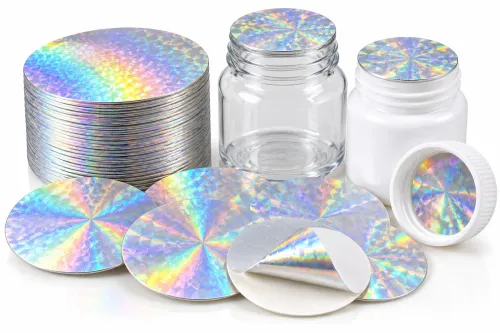
 | Holographic Induction Sealing Wads This is Two peice type induction sealing wads with HOLOGRAM or Holographic printing. View product → |
 | Sealing Wads Two peice tye Induction wads View product → |