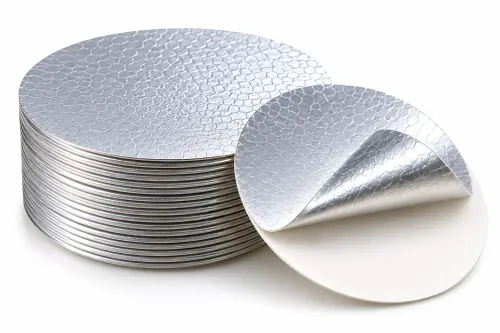

A wad that seals one bottle can fail on another because the container resin, sealant layer, product chemistry, cap compression and induction settings all interact. By the end, you will be able to match the sealant-facing layer to the container, narrow the construction by product type, and define a practical trial that exposes leaks, burn-through and loss of adhesion before production.
Key takeaways
- Match the sealant layer to the container material at the sealing land.
- Select wad construction based on liquids, powders, solvents, oils and moisture.
- Confirm wad, cap and neck dimensions before adjusting induction power.
- Test sealed packs under pressure, heat, storage and transport conditions.
Match the sealant-facing layer to the container material
A sealant-facing layer must match the material touching it at the container’s sealing land; the foil alone does not make a compatible seal.
| Material | Suitable facing | Selection point |
|---|---|---|
| PET | PET-qualified sealant formulation | Choose a PET induction wad, not a generic plastic liner. Confirm adhesion on the actual PET grade and neck finish. |
| HDPE | PE-based sealant | Use a PE-facing wad for an HDPE bottle seal. Do not substitute a PP-facing layer without testing. |
| PP | PP-based sealant | A PP container liner needs a PP-compatible facing that bonds across the complete land. |
| PVC | PVC-qualified formulation | Confirm PVC container compatibility with the resin, additives and any surface treatment; PE or PP facing is not automatically suitable. |
| Glass | Glass-qualified formulation | Match the wad to the glass finish, coating and cap compression. Glass tolerates different heat exposure from plastic. |
| Multilayer | Facing matched to the exposed sealing layer | Identify which polymer reaches the land. Select for that layer, not for an internal layer hidden beneath it. |
Treat each material and finish combination as a separate qualification. A wad that seals HDPE does not transfer automatically to PP, PET, PVC or glass, and a glass trial on one finish does not qualify every glass neck. Multilayer containers require testing after changes to laminate structure, tie layer or exposed coating.
Do not use a conventional foil wad on metal or metalized packages without specialist review: the package can shield the induction field or heat unevenly. Also qualify hot-fill, retort or sterilisation exposure separately, because a seal that passes immediately can peel or leak after processing.
Choose the construction for the product inside the pack
| Product inside the pack | Wad construction to consider | Main qualification point |
|---|---|---|
| Water-based liquids | Standard hermetic construction with a sealant compatible with the container | Confirm water-based liquid sealing after storage, inversion and leak testing |
| Oils | Use an oil-resistant sealant and adhesive system | Check for swelling, softening and loss of adhesion during shelf-life storage |
| Solvents and volatile chemicals | Select layers with proven solvent compatibility; use a vented design only when controlled vapour release is required | Store sealed samples in the actual formulation and test leakage, odour transfer and seal strength |
| Powders, granules and creams | Choose a construction that tolerates minor residue on the land | Product trapped under the wad causes powder contamination sealing failure; control filling, neck cleaning and cap application |
| Hot-fill, pasteurised or sterilised products | Use a heat-rated sealant and backing system | Test after the full temperature and exposure cycle, not only immediately after induction |
| Carbonated or gas-generating products | Consider a vented wad instead of a hermetic wad | Match vent rate, liquid holdout and orientation performance to the formulation; never substitute designs without pressure and leakage testing |
| Oxygen-sensitive goods | Use a low-oxygen-transmission, hermetic construction with an effective barrier layer | Measure oxygen ingress after sealing and throughout the intended storage period |
For creams, powders and sticky liquids, inspect the sealing land before capping. A clean, continuous contact area matters more than increasing induction power.
For volatile chemicals, oxygen-sensitive products and oils, qualify sealed samples at the intended temperature and shelf-life duration. A seal that looks sound on day one can lose adhesion after chemical attack or thermal exposure.
Set the wad, cap and neck geometry before choosing induction settings
A seal forms only when the wad covers the sealing land evenly, the cap compresses it correctly, and the neck remains within its specified geometry. Set those relationships before adjusting induction power or dwell time.
| Construction | After opening | Select when |
|---|---|---|
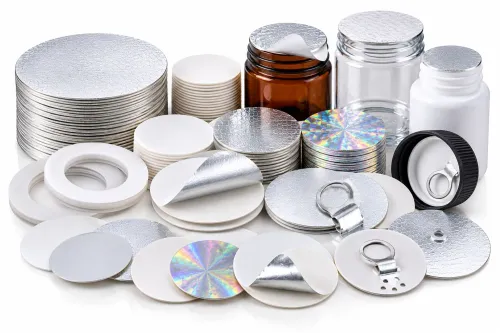
| Single-piece induction wad | Remains one liner structure; its opening behaviour must be specified as foil left on the bottle, retained in the cap, or removed as a peelable liner | You need a defined opening and resealing experience |
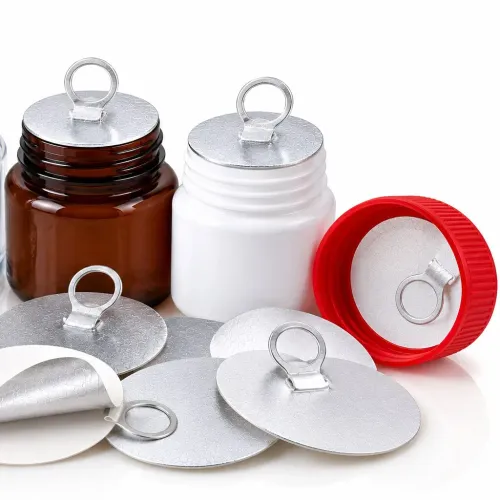
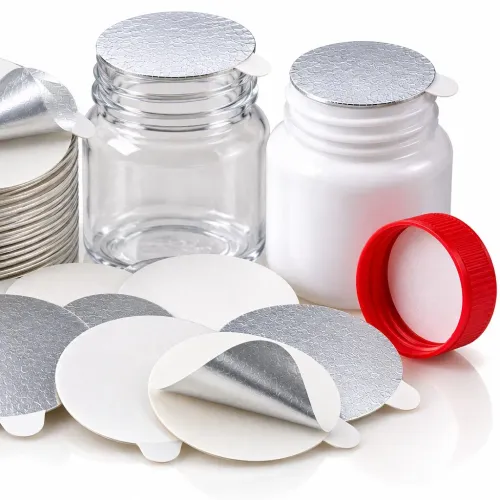
| Two-piece induction liner | The foil seal stays attached to the container while the backing layer remains in the cap | You want the bottle to show a visible foil seal after opening |
Measure the actual neck finish dimensions, including land width, bore, thread position, finish height, flash and ovality. Match the wad’s outside diameter to the land, keep its inside diameter clear of the bore and threads, and prevent the skirt from folding or dragging. A nominal neck size does not prove this fit.
Cap material and cap diameter change stiffness and compression. A flexible plastic cap and a rigid metal closure do not load the liner in the same way, even at the same nominal size. Centre the wad before capping; an offset liner leaves one side unsupported and creates a leak path.
Control cap torque with the selected cap, wad thickness, neck finish and capping machine. Low cap torque leaves gaps; excessive torque can distort the neck, squeeze out sealant and make opening difficult. Check the assembled closure for uniform contact before setting induction conditions.
Validate the complete package instead of increasing power
Test the complete package, not the foil alone. Induction sealing validation starts with production-representative samples and the actual sealer. A nominal neck match proves little: a wad can miss the land, touch the bore or compress unevenly when the finish is outside specification.
- Confirm that the filled container, cap and wad match production specifications. Check centering, land coverage, clearance from the bore and threads, cap seating, torque and compression; clean the land before capping.
- Run a planned induction trial across power, conveyor speed, head height and cap compression, then inspect the seal ring. Look for incomplete transfer, wrinkles, foil burn-through, melted sealant, neck deformation and backing damage.
- Challenge fill accuracy and closure application with water or the actual product, including deliberately contaminated sealing lands. Record peel or opening force separately: a strong peel result does not rule out channel leaks.
- Use a pressure-decay leak test on filled packs, with a defined pressure, stabilisation time and reject limit. Confirm failures with vacuum-decay or bubble testing, then repeat after filling, storage and thermal exposure.
Approve only a process window that passes every defined acceptance criterion across the machine’s normal speed and power range. If a pack fails, correct the underlying fit or application problem before increasing energy; excess power can hide a weak seal behind foil burn-through or a deformed neck.
Account for pressure, temperature, storage and regulatory exposure
Use a vented induction liner when the product generates gas and the package needs controlled release to prevent bloating or panel distortion. This applies to fermentable products and some carbonated product packaging; it does not mean every pressurised pack should vent. Compare vent rate, liquid holdout and orientation performance, then pressure-test the vented construction.
Never substitute it for a hermetic liner without leakage testing.
Qualify the complete seal after every expected exposure, not only immediately after induction:
- Refrigerated products: test after the coldest storage condition and again at room temperature; inspect for adhesion loss and channels.
- Frozen products: test after freeze-thaw cycles, checking curl, cracking and leak tightness.
- Hot-fill products: perform hot-fill seal qualification at the actual fill temperature, hold time and cooling profile.
- Sterilised products: use a sealant and backing system rated for the sterilisation cycle; a retort packaging seal must pass after processing, not just before it.
- Repeatedly temperature-cycled products: cycle filled packs through the specified high and low temperatures, then combine visual, peel or opening-force, and pressure-decay, vacuum-decay or bubble testing.
Record product-contact declarations and migration evidence for the actual formulation, temperature and contact time. Ask Surya Products Limited for construction-specific limits and test samples rather than treating a vented and non-vented wad as interchangeable.
Related products
 | Single Piece Induction Wads Keeping track with the latest market developments, we are engaged in offering an extensive range of Induction Sealing Wads. View product → |
 | INDUCTION SEALING WADS Paperboard, polyethylene and wax made two piece induction wads are reliable options for effective sealing of bottles and containers. View product → |
Frequently asked questions
How do you match an induction wad to container material?
Match the wad’s sealant-facing layer to the material forming the container’s sealing land, such as HDPE, PP, PET or glass. The foil itself does not determine compatibility.
How does the product inside the container affect wad selection?
Choose the wad construction according to the product’s liquid, powder, solvent, oil, moisture, temperature and chemical exposure. The product-contact layer must remain stable throughout filling and storage.
Why do wad, cap and neck geometry matter before setting induction power?
The wad must fit the cap and cover the neck sealing land evenly. Check neck finish, wad diameter, cap liner space, land width and compression before changing machine settings.
How should you validate an induction-sealed package?
Test the complete package for seal continuity, leaks, peel performance and tamper evidence, then expose it to expected pressure, temperature, storage and transport conditions.
Related products
 | Sealing Wads Two peice tye Induction wads View product → |
 | Vented Sealing Wads This is a special type of induction wads with Vent or Air membrane provided for passing of Gases and hot air through membrane. View product → |
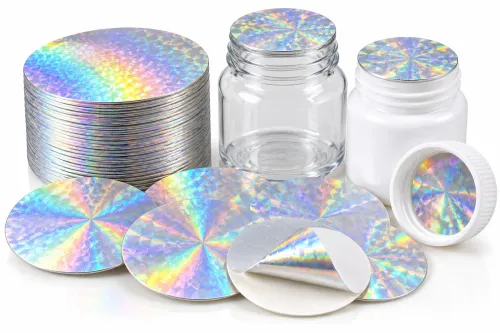
 | Holographic Induction Sealing Wads This is Two peice type induction sealing wads with HOLOGRAM or Holographic printing. View product → |
 | Vented Wads Designed as per health safety standard, these vented wads are used as reliable sealing options for HDPE and PET bottles containing chemicals. View product → |