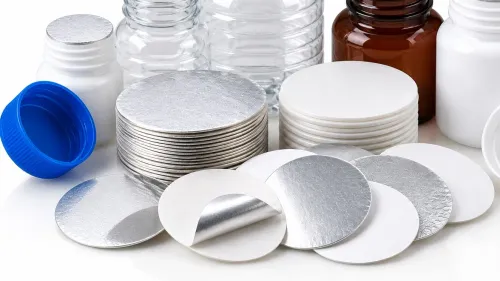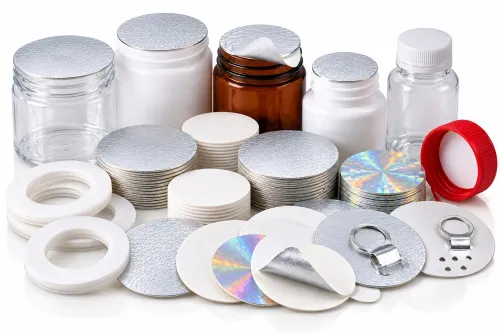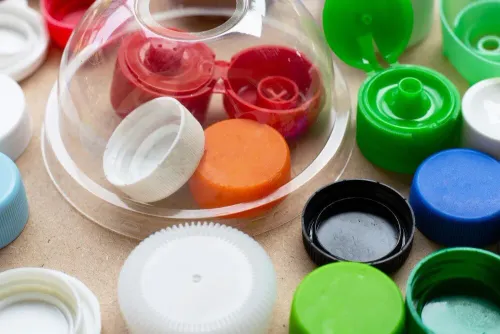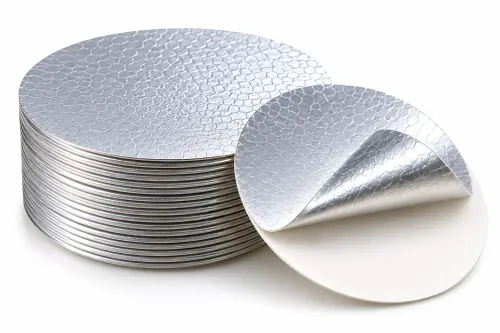
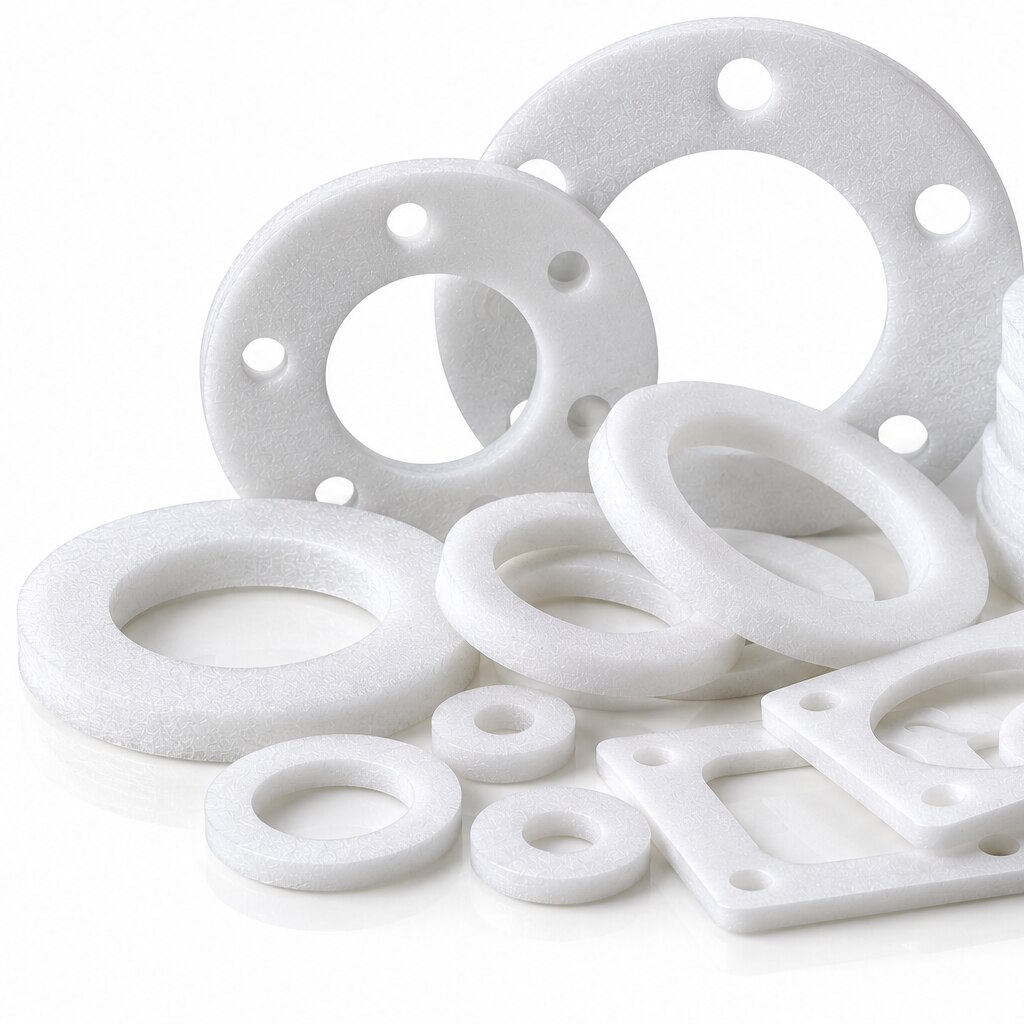
An EPE gasket works by compressing between the cap and bottle finish, absorbing small height and flatness differences while distributing application force. By the end, you will be able to match a gasket to closure geometry, install it without creating leak paths, set tightening and induction conditions, and verify performance after handling and aging.
Key takeaways
- Match the gasket ring to the bottle finish and cap geometry.
- Use controlled compression to cushion height and surface variations.
- Set torque within the closure system’s validated operating range.
- Test the complete liner, cap, bottle, and induction process together.
How compression turns EPE into a cushioning seal
A cap creates EPE gasket cushioning by pressing the foam between its underside and the bottle finish. Compression collapses the closed-cell foam locally, allowing it to conform to small differences in finish height, cap geometry, and surface irregularities.
That compliance spreads force across the sealing land instead of concentrating it at a few high points, while the foam absorbs vibration and helps prevent the closure from loosening during handling.
Cushioning is not the same as sealing. Cushioning maintains physical contact and reduces impact or point loading; sealing blocks the path for liquid, air, vapour, or contaminants. Uncoated EPE provides neither a hermetic oxygen barrier nor a high moisture barrier comparable to foil or a dedicated polymer sealant.
In an induction liner, that barrier function comes from the sealant layer and its bond to the container finish.
A softer foam can conform more readily, but it may lose thickness under sustained compression through compression set or creep. The result is falling contact pressure and a leak after storage, vibration, or pressure change. Choose EPE by measured recovery and load performance, not by softness alone.
Keep the distinction clear: EPE supports the seal by maintaining pressure, while the bonded sealant layer creates the actual barrier.
Match the ring to the finish before you install it
Measure both mating parts before installation: bottle-neck finish dimensions, cap inner diameter, cap depth, and the available compression space. Record the gasket outer and inner diameter and gasket thickness, then compare them with the cap and sealing land rather than relying on nominal bottle volume.
1. Inspect the finish for chips, tilt, flash, dust, product residue, mold-release contamination, and condensation. Reject a damaged finish; EPE cannot bridge a major gap or correct a crooked sealing land.
2. Confirm that the gasket outer diameter fits inside the cap without buckling, while the inner diameter clears the bottle opening and does not project into the mouth. Check that the gasket thickness leaves enough cap depth for controlled compression without bottoming out.
3. Place the gasket flat and concentrically in the cap. If the liner includes foil and a heat-sealable polymer layer, position the sealant side toward the bottle finish and follow the liner construction drawing.
4. Press the ring fully into its retaining feature, then inspect the circumference for folds, wrinkles, lifted edges, or double placement. A misplaced edge creates a leakage channel even when the centre appears compressed.
5. Apply the cap under the specified closure conditions and measure actual compression or closure height on sample assemblies. Open several caps to check that the ring remains flat, then perform a leak test; excessive torque, extrusion, or an uncompressed edge signals a dimensional mismatch.
Clean, even contact matters as much as diameter. Recheck fit after changes to cap supplier, bottle mould, gasket thickness, or closure torque.
Control compression, torque, and closure tolerances
A closure seals only when tightening force creates enough gasket compression to maintain contact around the entire sealing land. Closure torque that is too low leaves gaps over surface irregularities; torque that is too high can crush the EPE, distort the cap, or force material out of the sealing area.
Compression space is the usable distance between the cap and bottle finish after the closure seats. If the gasket is thicker than this space, the cap may stop before the threads engage fully, raising application torque and causing extrusion or wrinkles.
If the space is too large, the gasket cannot close minor gaps, so leakage channels remain.
Manufacturing variation turns a good nominal design into uneven pressure. Ovality and thread alignment can place heavy compression on one side while leaving the opposite side lightly loaded. Check torque together with cap seating height, gasket position, and visible contact; a torque reading alone cannot prove a seal.
Qualify the closure across its operating range:
- Apply at the specified torque window, then record seating height and inspect for wrinkling, folds, or extrusion.
- Repeat applications using production caps, finishes, and gasket lots to expose dimensional variation.
- Condition closed packs through hot storage, cold storage, vibration, and temperature cycling before leak testing.
- Measure torque retention and compression recovery. Excessive compression set reduces sealing force after sustained load, even when the package passes immediately after capping.
Use the lowest torque that achieves continuous contact and stable engagement, not the highest torque that prevents an immediate leak.
Validate the complete liner and induction process
A good result after induction sealing is not enough: qualify the liner, cap, bottle finish, machine settings, and storage history as one system. The foil and sealant layer must bond continuously around the finish without scorching, shrinking, or deforming the EPE.
Test the finished package at the conditions it will face:
| Test | What it reveals | When to use it |
|---|---|---|
| Seal-strength testing to ASTM F88/F88M | The force needed to separate the seal and whether failure occurs in the sealant, liner, or container finish | Compare induction settings, liner constructions, and aged samples |
| ASTM F2096 bubble test | Gross leaks found by internally pressurising the package and watching for bubbles | Screen for channels, folds, incomplete fusion, or damaged seals |
| Pressure-decay or vacuum-decay testing | Leakage under a measured pressure or vacuum change without relying on visible bubbles | Detect repeatable leak rates in production qualification |
| Temperature cycling and storage ageing | Seal retention after hot, cold, humid, or prolonged storage exposure | Test before and after the product’s defined distribution and shelf-life conditions |
ASTM F2096 does not prove that microscopic leak paths are absent. Use pressure-decay, vacuum-decay, or tracer-gas testing when the package has a strict leak-rate limit.
Remove samples after induction sealing, then test them immediately and after conditioning. Include the highest and lowest validated line speeds, power settings, cap compression, and foil temperature exposure; excessive heat can soften or partially melt EPE, while insufficient heat leaves the sealant unbonded. Record seal strength, leak results, failure location, batch, and storage condition.
A process passes only when every result remains within your stated limits.
Choose an EPE construction for the actual package
Select the liner against the actual finish, product viscosity, closure torque, filling temperature, storage duration, and expected temperature and pressure—not the nominal bottle volume. A thick syrup and a thin solvent expose the seal to different loads, while a wide finish needs different compression space from a narrow one.
| Construction | What changes | When to choose it |
|---|---|---|
| Lower EPE density | Softer conformity, lower load resistance | Minor finish variation and low internal pressure |
| Higher EPE density | Greater compression recovery and support | Long storage under load, heavier closures, or pressure-sensitive packs |
| Thinner EPE | Less cap-depth demand and lower compression force | Shallow closures with limited available compression space |
| Thicker EPE | More cushioning and tolerance compensation | Greater finish-height variation, provided the cap can compress it without distortion |
| EPE with polyethylene, ionomer, or other closure-grade sealant | Creates the bond to the container finish; EPE alone is not a hermetic barrier | Induction sealing or any package requiring a bonded seal |
Specify the density, thickness, cell structure, compression-set method, and compression recovery after storage under load. Require induction trials using the production cap, foil, sealant, container resin, line speed, and head settings; EPE thickness alone cannot predict seal quality.
Ask the supplier for:
- A layer-by-layer food-contact compliance file covering EPE, sealant, adhesive, foil coating, inks, and processing aids. Check 21 CFR 177.1520 for US food contact, or Regulation (EU) No 10/2011 and Regulation (EC) No 1935/2004 for EU supply.
- Samples matched to your finish drawing and closure depth.
- Recorded results for leak, peel, torque-retention, temperature-cycle, and pressure testing.
Surya Products Limited can help compare EPE constructions against these package-specific measurements rather than supplying a nominal ring alone.
Related products
 | EPE Ring Liners EPE gaskets are commonly used in dispensers to prevent leaks and maintain hygiene. View product → |
 | Epe Gaskets & Ring Liners These are EPE RINGS , Epe Gaskets for Spray Pump Caps , Mist Pump Caps , Sanitizer bottle Caps , Liquid detergent Caps , Lotion Pump Caps , Water... View product → |
Frequently asked questions
How does an EPE gasket create a cushioning seal?
The cap compresses the closed-cell EPE foam between the cap underside and bottle finish. The foam conforms to small differences in height, geometry, and surface smoothness.
How do you choose the correct EPE gasket ring?
Match the ring’s diameter, profile, and contact area to the bottle finish and cap. Confirm that it seats evenly without folding, overhanging, or missing the sealing land.
Why do compression and torque affect EPE sealing?
Compression closes gaps and provides cushioning, while torque controls how much force reaches the gasket. Excessive or insufficient torque can cause poor sealing, deformation, or closure problems.
What should you validate before using an EPE liner?
Validate the complete system: bottle finish, cap, EPE construction, liner placement, induction settings, torque, and finished-pack leak or seal performance.
Related products
 | EPE Ring Liners EPE Ring Wad For Fridge Bottle Cap An EPE ring liner is a type of liner made from expanded polyethylene foam that is commonly used in fridge bottle caps to provide a seal between the... View product → |
 | EPE LINERS / WAD Co-extruded 3 Layer EPE LIENRS Represents a single piece Expanded Polyethylene foam liner Material in punched Discs to specific dimensions or in Roll... View product → |
 | EPE LINERS WADS These are EPE LINERS & WADS used in Metal & Plastic Caps for Air tight , Leakage control And Moisture control from Bottles. View product → |
 | Easypeel Wads Aluminum foil based pull tab wad is reliable packaging sealing solution for FMCG, pharmaceutical and edible products. View product → |